German Language and Culture, Visual Studies, Disability, Digital Humanities, and Comedy
Wednesday, January 13, 2016
Schau mal! Google Releases Streetviews of Hamburg's Miniatur Wunderland
While reading one of my favorite technology blogs this morning (gizmodo), I learned that Google shrunk down one of its Streetview cars and drove it through the detailed dioramas of the Miniatur Wunderland in Hamburg. This is all the more exciting for me because, when I last visited Hamburg on a Tennessee Tech study abroad trip led by a colleague, I did not have time to view the Miniatur Wunderland, which I didn't mind because the price of admission seemed high at the time.
One of my best students GERM 1010 is a model train/landscape enthusiast and I am sure he will find this interesting. He's also planning on traveling to Germany this spring break through Tennessee Tech, but the trip won't take him to Hamburg this time. Schade!
I wonder if I can manage to integrate this into my German language classes somehow. The spectacle of Oktoberfest might be useful in the classroom.
Check out all the Streetviews here
Tuesday, January 12, 2016
CFP: Special Issue of JLCDS, ‘Drama, Theatrical Performance, and Disability’
I'm currently finalizing my abstract for a special issue of The Journal of Literary and Cultural Disability Studies focused solely on Drama and Disability. Back in September, I came across this CFP by chance, and I'm glad that I did. Its goals are aligned with my current book project on disability in German dramatic comedy, though my proposal explores a more canonical drama of the 20th century (more details later after I submit my materials).
I am curious to see what others are researching in the field, even though the issue won't be published until after Feb 2017.
Is anybody thinking of submitting a proposal? There's still time!
Labels:
CFP,
disability studies,
drama,
drama studies,
DS
Thursday, December 10, 2015
German Media and the Refugee Crisis
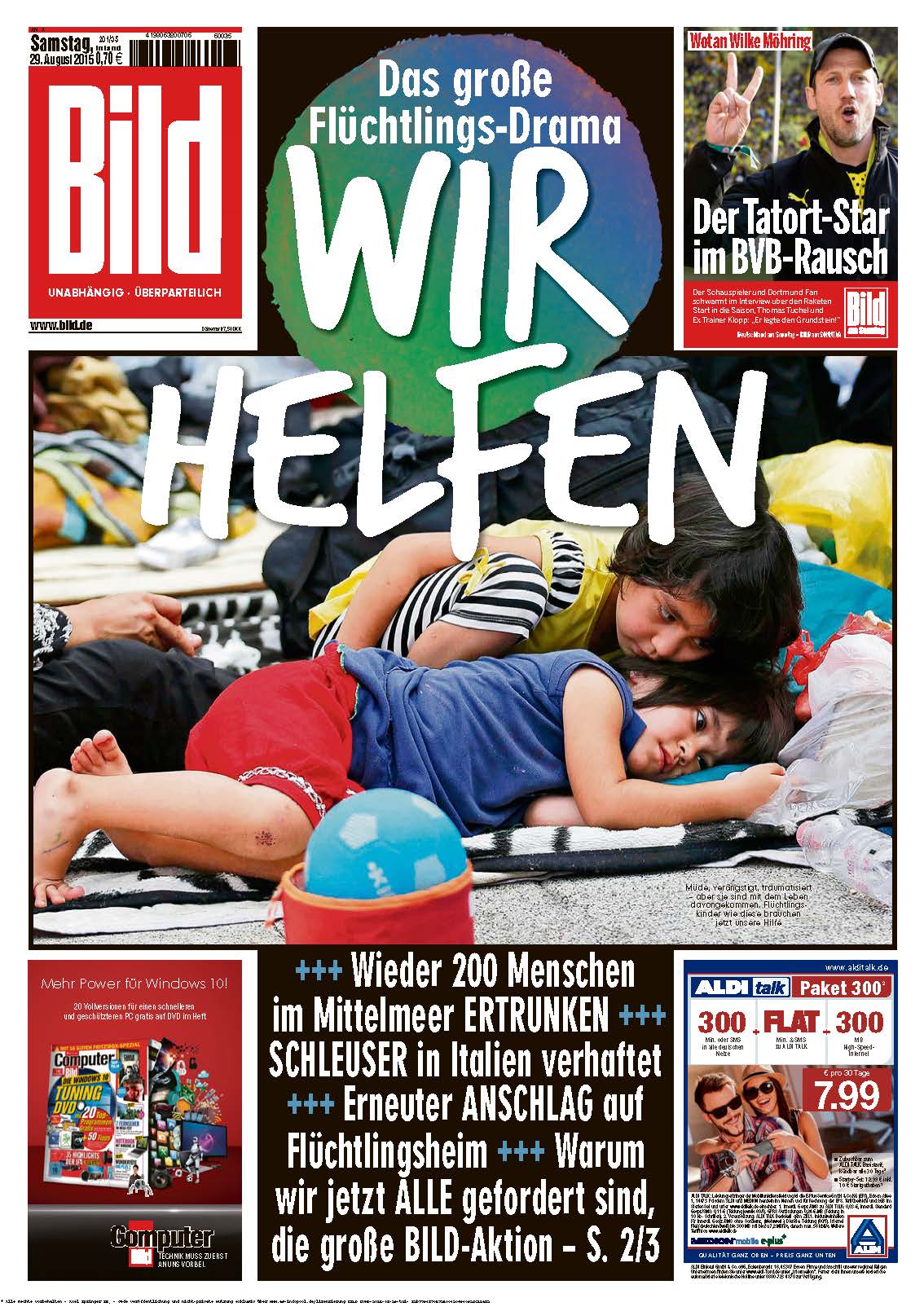
Bild cover, Aug. 29, 2015
Courtesy Bild
|
Recently, I helped an honors program student in my upcoming GERM 2020 course design an independent research project. Since he will be studying at the University of Aachen next academic year and since he hopes to join the foreign service later, I suggested he develop a project on the Syrian refugee crisis, its global context, and the role that the city of Aachen is playing as it develops. He will contact (and hopefully volunteer at) a refugee shelter in Aachen, but while he is gathering background information about the social, political, and cultural impact of the crisis, I'll be sure to share this article with him:
http://www.bloomberg.com/news/articles/2015-12-08/how-germany-s-right-wing-tabloid-learned-to-love-refugees
Unfortunately the article is not in German, but it does explore how the cultural institution (for better or worse) that is Germany's Bild newspaper is shifting with popular opinion.
Any other suggestions for where my student should start with this project?
Labels:
Aachen,
honors,
refugee crisis,
research,
teaching
Wednesday, December 9, 2015
STEM Teaching MOOC complete, Achievement unlocked
![]() |
| I might have to print this out and hang it in my office. |
I just received an electronic certificate of accomplishment for completing "An Introduction to Evidence-Based Undergraduate STEM Teaching". It was a great experience on a number of different levels:
First, I wanted to investigate the learner experience and the pedagogic structure of a MOOC. I will be teaching an online version of my general education course (GERM 2520 German Culture and Civilization) this coming spring, so this course offered many insights into both sides of the online delivery model.
Second, I saw this course as a great opportunity to learn more about instructional methods in the STEM fields. Having left science, math, and engineering behind so long ago, I was curious to see how STEM educators today prepare their students for the real-world application of course content. Unfortunately, most of my STEM colleagues I told about the course here at Tech were not able to complete it along with me, so we did not get to discuss methods or to collaboratively create learner experiences. Nevertheless, my colleagues (Chem Engineering, Geology, and Physics) and I did find time to have an hour-long discussion about the most valuable parts of the course which might have inspired them to take this course the next time it is offered.
Third, I wanted to insure that my instructional methods still reflect the best practices across the disciplines. I am constantly on the lookout for professional development opportunities like this, especially since we haven't had a teaching workshop here at Tech for a while now. Years ago, a course design workshop at the University of Virginia inspired me to adapt Eric Mazur's ConcepTest model to my humanities classroom, and I continue to find ways to integrate similar tools into my classroom. The ConcepTest model remains invaluable to me as a formative assessment and peer instruction tool, and it was vital to my flipped classroom (GERM 1010) this past semester Once I receive my course evaluations, I will be able to share some of my methods and results. Look for that in a future post.
Labels:
1010,
ConcepTests,
improvement,
teaching,
teaching portfolio
Wednesday, December 2, 2015
Happy Ghosts of Seminars Past
As our performances made clear, so many students made such large strides in this course. I can't tell you how many times initially timid students tell me in their final reflective essay that they wish they had tried out for a larger part. The experience gave them so much more confidence in their German, as a similar experience at the University of South Carolina had for me.
Wednesday, November 18, 2015
Culture in the Classroom: Die Geschichte vom fliegenden Robert
Whenever it is rains heavily in Cookeville, every student tends to drive, which means that parking is even harder to find for everyone. Given that I knew today's torrential rain meant many late students, I decided to use this situational factor to their benefit.
My 1010 students and I visually interpreted Heinrich Hoffmann's "Geschichte vom fliegenden Robert." Discussing weather was key to chapter 1 of Treffpunkt:Deutsch, so the first phase of our discussion was a great review of those previous communication goals. After we described how the first image constructs the idea of bad weather, I asked "Soll das Kind im Regen spielen? Warum oder warum nicht?". This engaged questions of recommendation/suggestion, which we've been trying to apply in class and differentiate from other modal constructions. I find that students tend to understand that they should use "sollen" to communicate recommendations/suggestions, but they rarely do this without direct prompting. Luckily the next two images in Robert's story demonstrate why he shouldn't play in the rain.
Actually, in the future and in more advanced classes, I could foresee using the stories out of "Struwwelpeter" to teach modal constructions. Given that the text and images are on wikimedia, this should be simple to integrate into a future textbook.
Wednesday, October 28, 2015
Butler University - German Language, Literature, and Culture: Getting Started
Over the weekend, while looking up a former colleague from my graduate student days at the University of Virginia, I stumbled upon this page of links (and even media), curated by subject librarian Franny Gaede. I found her collection to be such an excellent resource for students of German language, literature, and culture at all levels that I tweeted her out of the blue. Someone finally did all the hard work and collected (and organized) the best resources on the web. And today, I told my students about the site. Brava!
Labels:
culture,
for students,
links,
resources,
teaching
Tuesday, October 27, 2015
Monday, October 26, 2015
Mahlzeit! A German Brown Bag series - “Der Tatortreiniger” (Crime Scene Cleaner)
Please join Tech's German Club tomorrow for another
installment of Mahlzeit! A German Brown Bag series. We’ll watch an episode of
the very popular German comedy series “Der Tatortreiniger” (Crime Scene
Cleaner)—see the flyer for more details. Some light snacks will be
provided, and you are encouraged to bring your lunch to eat while you watch.
We hope to see you Tues, Oct 27, between 11:10 and 11:45am
in OKLY 212. More installments of Mahlzeit! will take place throughout the
semester (each featuring different TV shows), so if you can’t attend next week,
you will have more opportunities in November and December.
Labels:
co-curricular,
cultural event,
film series,
mahlzeit,
outreach
Saturday, October 24, 2015
Progress Report "Deutsch interaktiv - Einführung" iBook Part 1
It's been over two years now that "Deutsch interaktiv," the interactive textbook I planned, produced, and co-authored for the American market, has been available on iTunes. The "Deutsch interaktiv" iBook series was initially a side-project, a pedagogic experiment in a new medium--more a hobby than anything else. Back in 2011, I assumed that so many textbook publishers would be rushing to the new format, but, as things stand now in 2015, no major foreign language textbook publisher that I know of has made the leap. I assume it is because of Apple's price cap and an unwillingness to develop intellectual property for a medium that has no secondary market. (More on that gap in the market in Part 2 of this post.)
Anyway, part of my morning routine includes checking how many German language learners across the world have downloaded the iBook, and I am continually surprised and humbled to learn that at least a few people find the book each day.
You can find the free extended introduction to the "Deutsch interaktiv" series by following this link
![]() |
| The daily download record of Deutsch interaktiv-Einführung (July '14-Oct '15) |
I have noticed of late how more learners in Germany are downloading the iBook and its later chapters. Although I have no way of knowing, I hope that the iBooks are helping the many migrants who are undertaking the difficult journey from the Middle East to Germany. I've been talking with some publishers and other pedagogues about crafting a curriculum designed especially for migrant students. Some options already exist, and from what I have seen, they are effective enough, so I hope they support Germany's many new citizens.
Karoline von Günderrode's English #wiki WiG
A reason to host wikipedia hackathons! Will run the idea by Tenn Tech's German club at next meeting https://t.co/Y4zW92C91F— Martin P. Sheehan (@HerrSheehan) October 24, 2015
from Twitter https://twitter.com/HerrSheehan
October 24, 2015 at 06:31PM
via Arzillo Official Site
Sunday, February 16, 2014
Grammar in culture - Classroom Assessment
After participating in a number of ACTFL webinars last semester, I now focus regularly on providing a communicative, culturally rich frame for my classroom assessments. Here, my 3020 students are using Futur to indicate what will happen during next year's Karneval events. Beyond mere mechanical manipulation, students first learned about how the Kölner celebrate each Karneval event from a short description. Next, they wrote about next year, and then I asked them which separate event did they want to learn more about. It was no surprise to me that Weiberfastnacht was the most popular...it is the most challenging to discuss, given the tradition of women cutting off men's ties. The students found the dwtv video I played very entertaining and informative, their laughter seemed to suggest!
Saturday, January 25, 2014
CFP: Aura Today: Explorations of Corporeality and Materiality on the Modern Stage
German Studies Association Annual Meeting (GSA)
Kansas City, Missouri, September 18-21, 2014
Deadline: February 7 (Panel Submissions Due February 17)
Panel organizers:
Martin P. Sheehan (Assistant Professor of German, Tennessee Technological University; msheehan@tntech.edu)
Gerrit Roessler (Program Director, German Academic Exchange Service (DAAD); roessler@daad.org)
Walter Benjamin describes the dramatic stage as one of the few remaining spaces in which audiences can experience the aura of the work of art. While the means of reproduction eradicate this sense of presence and immediacy in most other forms of art, aura remains an integral part of theatrical performance, because “the artistic performance of a stage actor is directly presented to the public by the actor in person” as Benjamin observes in his famous essay The Work of Art in the Age of Mechanical Reproduction (1936).
However, we might argue that the modern stage challenges the very notion of presence and corporeality, opting instead for dramatic figures like Goethe’s Homunculus or Büchner’s Valerio who seem designed to displace the immediacy of the object on stage and frame it in terms of the audience’s imaginary. The dramatic stage is populated by objects and bodies that have no immediate material presence. We could say that they lack precisely what Benjamin calls “the here and now of the work of art.”
Given the tension that these and other figures create between performance, stage, and audience, this panel seeks to explore how dramas frame corporeality and its intersection with the alleged opposition of real and imagined bodies. How do dramatic texts portray objects that are sensually experienced, but not necessarily haptic, and vice versa? Particular attention will be paid to how bodies, products, or corporeal realities are culturally constructed, performed, or razed in the process of listening, viewing – and reading, during the course of performance.
In addition to the interplay of corporeality and identity, we want to explore how “real” and “imagined” corporeality comes into being. We are particularly interested in the close examination of how different texts and textualities employ the notion of what is abstract and concrete, seen and not seen, or heard and not heard in their construction and deconstruction of corporeality. Furthermore, the interplay of presence and absence, distance and closeness, immediacy and mediation, is of special interest.
Possible topics may include but are not limited to:
o Appearance and Disappearance
o Aura and Authenticity
o Seeing Is Believing
o The Aural and the Actual
o Sacred and Profane
o Imagined Communities
o Prosthetic Memories
o Icon(ic), Indexical constructions
o Benjaminian Aura as asset: its construction or destruction
o The Significance of Photographs as real or theoretical objects
o (Un)Real Places or properties and their qualities
Please send proposals (200-300 words) and a brief CV via email to both Martin Sheehan (msheehan@tntech.edu) and Gerrit Roessler (roessler@daad.org ) by February 7th. Final approval lies with the GSA Programming Committee.
German Studies Association Annual Meeting (GSA)
Kansas City, Missouri, September 18-21, 2014
Deadline: February 7 (Panel Submissions Due February 17)
Panel organizers:
Martin P. Sheehan (Assistant Professor of German, Tennessee Technological University; msheehan@tntech.edu)
Gerrit Roessler (Program Director, German Academic Exchange Service (DAAD); roessler@daad.org)
Walter Benjamin describes the dramatic stage as one of the few remaining spaces in which audiences can experience the aura of the work of art. While the means of reproduction eradicate this sense of presence and immediacy in most other forms of art, aura remains an integral part of theatrical performance, because “the artistic performance of a stage actor is directly presented to the public by the actor in person” as Benjamin observes in his famous essay The Work of Art in the Age of Mechanical Reproduction (1936).
However, we might argue that the modern stage challenges the very notion of presence and corporeality, opting instead for dramatic figures like Goethe’s Homunculus or Büchner’s Valerio who seem designed to displace the immediacy of the object on stage and frame it in terms of the audience’s imaginary. The dramatic stage is populated by objects and bodies that have no immediate material presence. We could say that they lack precisely what Benjamin calls “the here and now of the work of art.”
Given the tension that these and other figures create between performance, stage, and audience, this panel seeks to explore how dramas frame corporeality and its intersection with the alleged opposition of real and imagined bodies. How do dramatic texts portray objects that are sensually experienced, but not necessarily haptic, and vice versa? Particular attention will be paid to how bodies, products, or corporeal realities are culturally constructed, performed, or razed in the process of listening, viewing – and reading, during the course of performance.
In addition to the interplay of corporeality and identity, we want to explore how “real” and “imagined” corporeality comes into being. We are particularly interested in the close examination of how different texts and textualities employ the notion of what is abstract and concrete, seen and not seen, or heard and not heard in their construction and deconstruction of corporeality. Furthermore, the interplay of presence and absence, distance and closeness, immediacy and mediation, is of special interest.
Possible topics may include but are not limited to:
o Appearance and Disappearance
o Aura and Authenticity
o Seeing Is Believing
o The Aural and the Actual
o Sacred and Profane
o Imagined Communities
o Prosthetic Memories
o Icon(ic), Indexical constructions
o Benjaminian Aura as asset: its construction or destruction
o The Significance of Photographs as real or theoretical objects
o (Un)Real Places or properties and their qualities
Please send proposals (200-300 words) and a brief CV via email to both Martin Sheehan (msheehan@tntech.edu) and Gerrit Roessler (roessler@daad.org ) by February 7th. Final approval lies with the GSA Programming Committee.
Tuesday, October 15, 2013
das Sniglet
I will be posting the entire list outside my office.
Wednesday, October 2, 2013
TTU's German Klub Hosts Oktoberfest, (10/10)
Tennessee Tech's German Klub is happy to announce the details of its upcoming Oktoberfest celebration. Those who attend will be treated to a slice of Bavaria, complete with music, food, and other insights into German culture.
Wednesday, September 11, 2013
Updated CV
I'm applying for a few more grants this Fall while I have the time, energy, and the projects to develop.
Tuesday, September 10, 2013
Digital Humanities - First Foray
Thanks to my current Faculty Research Grant from Tennessee Tech U, I have more time to explore what interests me at the moment--the intersections of literary studies and technology. I am in contact with many colleagues at other institutions who received training in the Digital Humanities, and I am hoping to learn about the new discipline by collaborating with my colleagues. Over the summer, Katie Rawson (currently, a Clir fellow at UPenn Library) introduced me to a few of the research tools at a DH scholar's disposal, and during a stroke of creativity this morning, I came across Voyant Tools and decided to take the first step in developing a new project (more on that when I have enough to share). Here is the result of my work this morning:
Click here to view the Cirrus Word Cloud on Voyant
A Word Cloud of the Woyzeck Corpus (at least, the corpus available on Project Gutenberg).
What surprises me most is that "ich" (the pronoun "I") appears nearly as frequently as "Woyzeck". The protagonist Woyzeck is in nearly every scene of the dramatic fragment, and other characters (der Hauptmann, der Doktor, especially) call him by his first name, mainly because they are constantly admonishing him. Still, the frequency of "ich" is surprising, and bears some deeper analysis with DH tools. Which character uses "ich" most often? Another interesting area to explore would be which characters do not use "ich"?
This is just a cursory Word Cloud. Given more time, I will refine how I use Voyant and explore how other scholars have used similar tools to analyze texts.
Do you have any conclusions to draw about "Woyzeck" from the word cloud? Any suggestions of what my next step should be?
Click here to view the Cirrus Word Cloud on Voyant
A Word Cloud of the Woyzeck Corpus (at least, the corpus available on Project Gutenberg).
What surprises me most is that "ich" (the pronoun "I") appears nearly as frequently as "Woyzeck". The protagonist Woyzeck is in nearly every scene of the dramatic fragment, and other characters (der Hauptmann, der Doktor, especially) call him by his first name, mainly because they are constantly admonishing him. Still, the frequency of "ich" is surprising, and bears some deeper analysis with DH tools. Which character uses "ich" most often? Another interesting area to explore would be which characters do not use "ich"?
This is just a cursory Word Cloud. Given more time, I will refine how I use Voyant and explore how other scholars have used similar tools to analyze texts.
Do you have any conclusions to draw about "Woyzeck" from the word cloud? Any suggestions of what my next step should be?
Tuesday, August 6, 2013
Twenty things you didn't know about Germany
Photo: Getty Images
I can't claim I knew the fact about the Trabant, though I will share this with Tennessee Tech's German students.
Also, I'll try my best to track down a copy of Rick Stein’s 'German Bite’ for a screening at this year's Filmabend. I already plan to share the BBC's "Das Auto: The Germans, Their Cars and Us", which should grab the attention of our engineering students, given that Volkswagen recently opened a plant in Chattanooga.
You can read the list here
Thursday, July 4, 2013
First Review of Deutsch Interaktiv: Bausteine
Saturday, June 15, 2013
Deutsch Interaktiv Thema 1 available on iTunes
It is with pleasure that I announce that Deutsch Interaktiv Thema 1 is now available for purchase in over 53 iTunes stores worldwide. The interactive book uses ACTFL best practices to guide learners through the rudiments of German. Our Einführung (Introduction) iBook was downloaded over 1500 times by people across the globe, and we hope Thema 1 will be as popular.
Subscribe to:
Posts (Atom)